


The Dinner Party That Influenced History

Updated: Jun 7
Grand-Pré and Longfellow's Evangeline.
When was the last time you turned down an invitation because staying in seemed easier?
On April 5, 1840, a small group of friends gathered for dinner in Cambridge, Massachusetts. In attendance were two of America's most acclaimed authors: Henry Wadsworth Longfellow and Nathaniel Hawthorne. Another guest, Boston reverend Horace Conolly, told a story that he hoped one of them would turn into a novel.
Reverend Conolly had heard the story from a French-Canadian woman in his parish – about an Acadian couple separated on their wedding day by the British expulsion of 1755, and the woman's lifelong search to find the man she loved.
Hawthorne declined. "It is not in my vein," he told Conolly. "There are no strong lights and heavy shadows."
Longfellow, however, saw something else entirely in the same story: a tale of resilience and undying love, with a historical injustice – largely forgotten – as its backdrop. He spent the next seven years writing Evangeline: A Tale of Acadie, published in 1847.
The poem was immediately and enduringly popular, running to 270 editions and 130 translations over the next hundred years. Evangeline became required reading for generations of American schoolchildren.
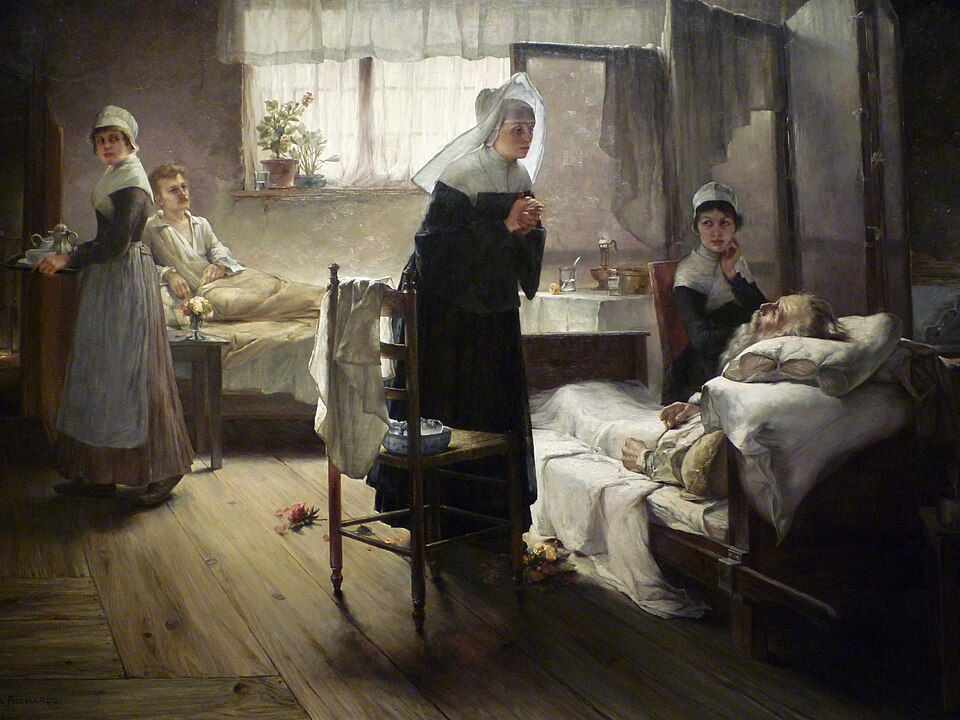
Longfellow became, in the language of our time, an influencer. His fictional Acadian heroine became the emotional entry point through which millions of people first encountered the history of the Deportation. Many, particularly Americans, travelled to Nova Scotia seeking the dykes, the ancient well, the church where Evangeline had last seen her beloved Gabriel. They wanted to stand in the place Longfellow had imagined.
By 1871, steamship and rail service from New England to Nova Scotia was actively marketing the region as the "Land of Evangeline."
The Windsor and Annapolis Railway had noticed that Longfellow's poem was shaping vacation plans, and built its tourist identity around it. When the railway evolved into the newly formed Dominion Atlantic Railway in 1894, that identity came with it. |  |
Grand-Pré was not prepared for the onslaught. Tourists arrived seeking tangible souvenirs. Some grabbed handfuls of pebbles. Some aggressively carved their names into the ancient willow trees that grew along the dykes. Others, in pursuit of more macabre keepsakes, dug up Acadian gravesites. This is what genuine cultural impact looks like, and it is not always dignified.
It took a Nova Scotian jeweller and historian named John Herbin to step in and protect the site. In 1907, he purchased 14 acres of land where the original Acadian community had stood. The following year, the Nova Scotia government passed an Act to recognise and preserve the Grand-Pré Historic Grounds – the first time any government had taken steps to protect the site.
The Evangeline statue was unveiled in 1920. The Memorial Church was erected in 1922, and its interior completed in 1930. That same year, the Canadian government honoured the site with the 50-cent stamp Acadian Memorial Church, Grand-Pré, NS (Scott #176).
In 2012, the Landscape of Grand-Pré became a UNESCO World Heritage Site.

Would any of that have happened without Longfellow's poem? It is genuinely hard to say. The injustice was real and documented. But documented injustice without an emotional hook has a way of being quietly overlooked by history.
What we know is this: an unnamed woman told her reverend a story. The reverend brought it to a dinner table. A poet heard the story and spent seven years turning it into a love story the world could not put down – one that became a symbol of Acadian identity and survival that endures to this day. None of them knew what they were setting in motion.
Which is, perhaps, the best argument anyone has made for accepting the dinner invitation.
© 2026 Canafete. The writing and original designs here are mine. You're welcome to share a short excerpt with credit and a link back to Canafete.ca. For anything more, including reprinting a full post, just ask: contact@canafete.ca
Further Reading
Longfellow, H.W. Evangeline: A Tale of Acadie (1847) – available free through Project Gutenberg at gutenberg.org
Landscape of Grand Pré, Century of Tourism and Agriculture: landscapeofgrandpre.ca/century-of-tourism-and-agriculture.html
Landscape of Grand Pré, National Historic Site: landscapeofgrandpre.ca/national-historic-site-parks-canada.html
Parks Canada, Grand-Pré National Historic Site: parks.canada.ca/lhn-nhs/ns/grandpre
Haliburton, T.C. An Historical and Statistical Account of Nova Scotia (1829) – digitised through Harvard University, available at archive.org
(1) Samuel G. Richards (1853 - 1893). Public domain via Wikimedia Commons
(2) Photograph from Dominion Atlantic Railway Digital Preservation Wiki Initiative - Steve Meredith collection. http://DARDPI.CA/wiki/index.php?curid=3416
(3) Dr Wilson. User Semhur on the french wikipedia, modified the original picture., CC BY-SA 3.0 http://creativecommons.org/licenses/by-sa/3.0/ via Wikimedia Commons


